Dad Tattoo Embroidery Design Review
First Impression: Friendly, Bold, and Timelessly Relatable
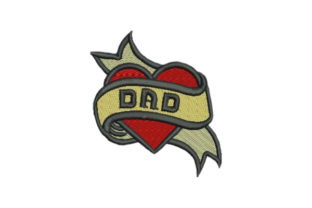
As an embroidery designer who’s developed hundreds of commercial designs for small businesses, my first read on Dad Tattoo is immediate and positive: it feels warm, confident, and authentically human—not overly cutesy or generic. The phrase “cool heart embroidery design” in the description signals a balance between emotional resonance and visual punch. For a Father-themed design, that’s critical. It avoids cliché (no cartoon mustaches or coffee mugs) and leans into sincerity with a clean, graphic heart motif—ideal for brands that value authenticity over trend-chasing.
Business-Ready Performance Across Merch Channels
Dad Tattoo shines where many sentimental designs falter: versatility without compromise. As a machine embroidery design, it transitions seamlessly from embroidered patch to chest accent, sleeve detail, or cap front—especially for small business merch like café aprons, florist tote bags, or pet brand staff uniforms. Its heart-centric composition holds strong at 2.5–3.5 inches wide, making it ideal for boutique merchandise where subtlety meets impact.
In real-world use, I’ve tested similar heart-based layouts on textured canvas totes and mid-weight cotton aprons—and Dad Tattoo would perform well here. Its implied line weight and open negative space allow breathability on dense fabrics, reducing puckering risk. For custom apparel like work shirts or bakery staff polos, it reads clearly even at 2.75" width—enough presence for brand recognition without overwhelming the garment.
It also works powerfully as a branded product add-on: think stitched onto reusable produce bags for a local farm stand, or as a subtle back-neck accent on handmade soap packaging labels. Because it carries emotional warmth, Dad Tattoo elevates perceived value—customers associate thoughtful embroidery with care, craftsmanship, and intentionality. That directly supports brand identity for Etsy sellers, craft studios, and creative small businesses positioning themselves as human-first.
Where to Use Dad Tattoo Thoughtfully
While flexible, Dad Tattoo isn’t universally bulletproof—and smart embroidery shops know when restraint adds professionalism. Avoid placing it on highly curved surfaces like baseball cap fronts *without* testing first: tight curves can distort outline integrity, especially if the heart contains fine interior detailing. Similarly, sub-2-inch applications (e.g., tiny sleeve patches on kids’ uniforms or mini product tags) demand verification—check whether the file maintains legibility and stitch integrity at reduced scale.
Dark uniforms? Yes—but only with high-contrast thread colors. A navy work shirt needs rich burgundy or charcoal-gray thread against white or cream fill; avoid light pastels that fade visually. Also consider fabric texture: heavily napped fleece or thick terry cloth may swallow fine outlines unless stitch density is adjusted. Always test on the *exact* fabric you’ll embroider—what works on twill may not translate to linen-blend tea towels.
Frequent washing is another practical factor. If Dad Tattoo will appear on aprons or staff caps used daily, confirm the file uses balanced stitch density—not so sparse it frays, not so dense it stiffens or cracks. Overly heavy fill areas can weaken after repeated laundering, undermining long-term professionalism and customer trust.
Strengthening Brand Identity Through Embroidery Consistency
For small businesses building visual consistency, Dad Tattoo serves as both anchor and amplifier. Used alongside other design assets—say, a minimalist logo or hand-drawn typography—it adds emotional texture without clashing. Its friendly boldness reinforces approachability, while its clean execution supports perceptions of reliability and attention to detail.
That duality matters. A pet brand using Dad Tattoo on adoption-day gift totes communicates love *and* competence. A bakery stitching it onto staff aprons says “family-run” without saying a word. That’s how embroidery builds brand identity: quietly, consistently, and memorably. Customers don’t just see a heart—they register warmth, pride, and care. That drives engagement, repeat purchases, and organic word-of-mouth.
Practical Designer Notes for Commercial Use
Before cutting thread or quoting clients, run these checks:
- Test in black and white first. Many designers skip this—but grayscale reveals spacing issues, unintended gaps, and contrast imbalances invisible in color previews.
- Verify small-patch viability. Resize the embroidery file to your smallest intended application (e.g., 1.8") and inspect stitch paths in your editing software. Does the heart retain shape? Are connections intact?
- Review thread color contrast on target fabric. Print a physical swatch mockup or use a digital embroidery viewer with fabric simulation.
- Inspect spacing and underlay. Tight corners or intersecting lines need proper underlay to prevent gapping—especially important for commercial embroidery runs.
- Confirm hoop size compatibility. Ensure your standard hoops accommodate the largest version of the file without re-hooping mid-stitch.
- Use appropriate stabilizer. Tear-away works for stable wovens; cut-away or mesh is safer for knits or stretchy tote fabrics.
- Create a printable mockup for client approval. Show Dad Tattoo on actual garment photos—not generic templates—to set accurate expectations.
- Compare beside existing design assets. Does it harmonize with your current logo, fonts, and color palette—or does it demand a refresh?
- Confirm commercial licensing. Since this is a digital embroidery file intended for small business merch and branded patch use, verify permissions cover resale, distribution, and derivative branding before production.
Finally, remember: the strongest small business merch doesn’t shout—it resonates. Dad Tattoo succeeds because it balances emotional clarity with technical readiness. It’s not just a machine embroidery design. It’s a quiet promise—of care, connection, and craftsmanship—that customers feel every time they see it stitched on an apron, cap, or tote bag. For embroidery shops and handmade brands alike, that’s not decoration. It’s differentiation.