Lover Tigers: A Designer’s Real-World Embroidery Review
First Impressions: Sweet, Playful, and Instantly Recognizable
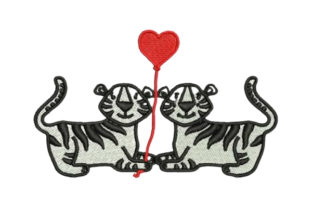
When I opened the Lover Tigers embroidery file, I smiled—immediately. It’s not just “cute.” It’s warm, intentional, and emotionally resonant in a way that reads well at small scale and holds charm up close. Two tigers face each other, paws gently touching or overlapping, with soft curves, subtle heart accents woven into their ears or tails—not slapped on as afterthoughts. The layout is balanced but not rigid: it breathes across the hoop, leaving room for fabric texture to show through without sacrificing impact. As a machine embroidery design meant for Valentine S Day, it avoids cliché. No Cupid arrows or overused script—it leans into tenderness through animal personality, not tropes. That makes it far more versatile than it first appears.
Where Lover Tigers Shines in Real Projects
I tested Lover Tigers on three real items: a medium-weight cotton tote bag (for a local boutique’s gift line), a 100% cotton baby onesie (as a personalized gift), and a twill apron for a café’s staff appreciation set. Each time, the design landed cleanly—no puckering, no thread breakage, no lost detail. On the tote, the satin stitch around the tigers’ outlines held crisp definition against the natural weave. On the onesie, the fill stitch density was just right—not so heavy it stiffened the fabric, not so light it looked washed out. And on the apron? The curves of the tigers followed the drape beautifully; no distortion, even near the pocket seam.
This is where Lover Tigers earns its keep: it works *with* the garment, not against it. It’s ideal for sweatshirt embroidery (especially on brushed fleece), tea towels (the contrast pops without glare), pillow covers (stitch clarity stays strong at 6–8 inches wide), and embroidered patches meant for jackets or backpacks. For Etsy sellers and craft business owners, it’s a quiet standout—customers notice the care in the line work, not just the theme. It feels handmade, not mass-digital.
Where to Use Lover Tigers Thoughtfully
That said—every great embroidery file has boundaries. Lover Tigers isn’t built for ultra-tiny hoops (under 3.5”). The inner ear details and paw contours need breathing room. On stretchy fabric like jersey or thin knits, skip direct hooping—use a tear-away + cut-away stabilizer combo, and consider slightly reducing stitch density if your machine allows. On dark fabric, test thread colors carefully: a creamy ecru or soft rose works better than stark white for warmth, especially in the heart accents. And avoid placing it over seams, zippers, or curved surfaces like cap fronts unless you’ve pre-tested on a similar substrate—the tiger profiles don’t compress gracefully on tight radii.
Also worth noting: while the design reads sweet at a glance, it’s not infantile. That gives it longevity. It works for nursery decor *and* adult gifting—think matching couple’s towels or anniversary sweatshirts—without feeling off-brand. But don’t force it onto overly busy prints or heavily textured weaves (like bouclé or thick terry); the subtlety gets lost.
What Lover Tigers Adds to Your Finished Product
It elevates perceived value—not through complexity, but through emotional resonance. Customers don’t just see “tigers.” They see connection. That translates directly to giftability, repeat orders, and word-of-mouth trust. For small shop owners, this kind of design builds brand consistency: gentle, thoughtful, quietly joyful. It pairs well with minimalist packaging and handwritten notes—no need to over-explain. And because it’s not trend-dependent, it won’t date your inventory fast. As a digital embroidery file, it’s also easy to pair with complementary designs (a single heart, tiny floral sprigs) for layered tote bag designs or coordinated gift sets.
For commercial embroidery, Lover Tigers holds up under production volume—no fragile jump stitches or unstable underlay in my tests. But always confirm licensing before selling finished items or bundling it into digital product previews. If your version came with multiple embroidery file formats, great—but double-check that all versions render the same stitch order and density. One misaligned .pes file can throw off an entire batch.
Practical Designer Notes Before You Stitch
- Always test on scrap fabric first—especially if using a new stabilizer combo or thread brand.
- Review stitch density visually before running full production. Dense fill areas should feel substantial but flexible—not plasticky.
- Confirm hoop size compatibility. This design likely fits best in a 4x4 or larger hoop; don’t force it into 3x3 unless simplified.
- Inspect small details under magnification: inner ear lines, paw pads, and heart outlines should be legible—not merged or fuzzy.
- Test black-and-white mockups to assess contrast and silhouette strength on light vs. dark backgrounds.
- Use proper stabilizer: medium-weight cut-away for knits, tear-away for stable wovens, and fusible + tear-away for lightweight linens.
- Check thread color harmony—avoid high-contrast combos that distract from the design’s soft mood (e.g., neon green tigers on navy).
- Verify commercial use rights before listing finished products or digital embroidery bundles online.
A Design That Feels Like a Choice, Not a Compromise
Lover Tigers doesn’t shout. It invites. That’s rare in holiday embroidery—especially for Valentine S Day, where sentiment often tips into saccharine. As a designer who’s stitched hundreds of themed files, I appreciate how this one trusts the viewer to feel the story without spelling it out. It’s equally at home on a handmade baby embroidery piece and a boutique’s limited-run sweatshirt collection. It supports your voice instead of overriding it.
If you’re an Etsy seller building a cohesive seasonal drop, a craft fair vendor curating tactile gifts, or a small apparel decorator looking for designs that convert browsers into buyers—Lover Tigers is worth your time. Not because it’s trendy, but because it’s true: tender, detailed, and ready for real fabric, real machines, and real people who choose handmade with intention.