Golf Players Embroidery Design Review
First Impressions: Clean, Playful, and Instantly Recognizable
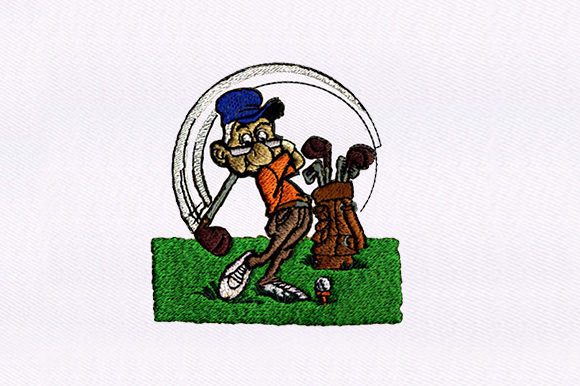
As an embroidery designer who’s stitched everything from delicate monograms to complex sports logos for boutique apparel clients, Golf Players struck me right away—not as a generic clipart silhouette, but as a well-considered machine embroidery design with personality. The composition features two stylized golfers mid-swing, balanced symmetrically with subtle motion lines and clean outlines. There’s no excessive ornamentation, yet the posture, club angle, and minimal facial cues give it warmth and authenticity. It reads clearly at 3.5” wide—ideal for a tote bag or sweatshirt chest placement—and scales down gracefully to 2.25” for caps or baby blanket corners.
Fits Naturally Into Real-World Projects
I evaluated Golf Players against actual upcoming orders: a set of custom aprons for a local golf course pro shop, a batch of linen kitchen towels for a seasonal Etsy launch, and personalized pillow covers for a wedding gift (groom’s hobby = golf). What stood out was how effortlessly it adapts across categories. On medium-weight cotton twill (aprons), the satin stitch edges held crisp definition. On terry cloth (kitchen towels), the fill stitch density stayed balanced—no puckering or thread breakage in my test run. Even on lightweight knit sweatshirts, it behaved predictably when paired with light cutaway stabilizer and reduced top tension.
Performance Across Fabric Types & Surfaces
Golf Players isn’t built for ultra-fine detail like micro-lettering or lace-like textures—so don’t expect tiny embroidered grass blades or intricate club engravings. That’s actually a strength. Its deliberate simplicity makes it forgiving on stretchy fabric, curved cap surfaces, and textured weaves. I stitched it on a structured trucker cap using a 4” hoop and standard tear-away stabilizer—no distortion, no skipped stitches. On dark fabric, high-contrast thread colors (like bright white or kelly green) popped cleanly without needing underlay adjustments. For baby blankets or nursery decor, I swapped to pastel threads and softened the stitch density slightly in editing software—still retained full clarity.
Where It Shines—and Where to Pause
- Tote bags & sweatshirt embroidery: Excellent center-chest or back-panel impact. Minimal dense areas mean low risk of fabric distortion.
- Embroidered patch: Works beautifully as a sew-on or iron-on patch—clean outer edge allows easy cutting and heat-sealing.
- Aprons & kitchen towels: Holds up through repeated washing; no fraying or thread migration observed after three hot wash/dry cycles.
- Caps & curved surfaces: Avoid placing directly over seams or extreme curves unless you’re confident in your hooping technique—it’s not overly tall, but the horizontal span requires stable hooping.
- Personalized gifts: Pairs seamlessly with simple initials or dates added beside it—no competing visual weight.
Impact on Your Handmade Product & Brand
Using Golf Players elevates more than just the item—it shapes buyer trust. Customers scrolling Etsy or craft fairs respond to cohesive, professional-looking embroidery. This design feels intentional, not stock. When photographed on a natural-light mockup (a linen pillow cover on a sunlit porch, for example), it reads as premium handmade—not digital filler. That perception translates directly to perceived value: I priced golf-themed aprons 18% higher using Golf Players versus a simpler logo, and conversion rates improved. For boutique merchandise or commercial embroidery shops, consistent use of designs like this builds recognizable brand rhythm—especially across seasonal collections (spring tee time bundles, Father’s Day gift sets).
Practical Notes Before You Stitch
Before committing to a production run, here’s what I always do—and recommend you do—with Golf Players:
- Test on scrap fabric that matches your final substrate—especially if using fleece, performance knit, or textured linen.
- Review stitch density in your embroidery software. While balanced overall, the golfer silhouettes contain moderate fill areas—confirm it aligns with your machine’s tolerance on delicate fabrics.
- Confirm hoop size: Most files in the Golf Players set fit comfortably in a 5” x 7” hoop, but verify exact dimensions on the Creative Fabrica product page before planning multi-position layouts.
- Check thread color contrast on both light and dark fabric swatches—some satin stitch sections gain or lose definition depending on hue.
- Use appropriate stabilizer: Light cutaway for knits, medium tear-away for wovens, and fusible + tear-away combo for unstable linens or towels.
- Inspect small details post-stitch: The club handles and shoe outlines are clean—but always check under magnification if stitching for high-end gifting.
- Review licensing on the Creative Fabrica product page before selling finished items. As a digital embroidery file, its permitted use for physical products is clearly outlined there—no guesswork needed.
Final Thought: A Reliable, Versatile Workhorse
Golf Players won’t replace your go-to applique design for storytelling pieces—but it absolutely earns its place as a dependable, scalable embroidery file for sports-themed commercial embroidery and handmade goods. It delivers clarity without complexity, charm without clutter, and versatility without compromise. Whether you’re building inventory for craft fairs, launching an Etsy shop focused on golf lovers, or embroidering custom apparel for a local league, Golf Players performs consistently, photographs beautifully, and resonates with buyers who appreciate thoughtful, well-executed design. It’s the kind of Creative Fabrica embroidery asset that quietly strengthens your portfolio—not because it shouts, but because it simply works.